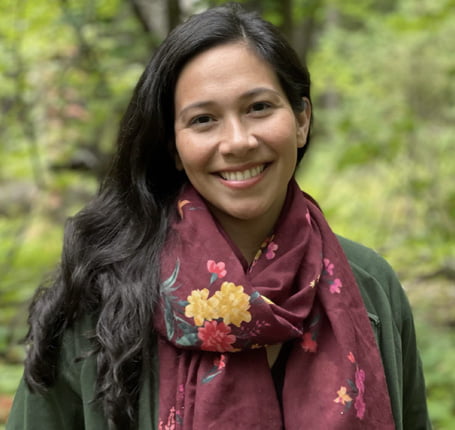
Dr. Miigis Gonzalez (Lac Courte Oreilles Ojibwe) is an Assistant Scientist for the Johns Hopkins Bloomberg School of Public Health, Center for American Indian Health, Great Lakes Hub. Her research is grounded in her values, beliefs, and personal experiences as an Anishinaabe woman, mother, and leader. Her research promotes Indigenous language and culture as the means to improve wellbeing among Indigenous peoples. Her work supports what is innately understood among Indigenous people – that language, culture, and spirituality are inseparable components of Indigenous wellbeing; and that we cannot deny contemporary experiences of loss and disconnection. As a new faculty member (2021), she hopes to utilize research and the resources of Johns Hopkins to create new opportunities to increase access to Indigenous language, culture, and wellbeing for Anishinaabe peoples. In addition, Miigis is a parent (with her three children) of Kokonaan Endaad (Grandma’s House), an Ojibwe language nest. Kokonaan Endaad brings together parents, babies, and elders in a cultural, immersion setting to revive the language, the culture, Anishinaabe parenting practices, and ultimately, to raise a new generation of first language speakers. Miigis is dedicated to engaging her young family in cultural and ceremonial spaces because it is within these spaces that Anishinaabe teachings are alive and transferable. As MIIN Board Chair, she is committed to supporting and understanding the needs of our community leaders who are actively reviving Ojibwe language in their programming. As a parent and second language learner, she is grateful for this continuous and collaborative work towards language revival.

Michael Migizi Sullivan Sr., PhD is a homegrown Anishinaabe scholar from the Lac Courte Oreilles Ojibwe reservation in northern Wisconsin. Well known for his community language work, Dr. Sullivan has formally served as the Resident Linguist for the Waadookodaading Ojibwe Language Institute, Faculty Director of Native American Studies for the Lac Courte Oreilles Ojibwe University, Chair of American Indian Studies at the College of St. Scholastica, as well as various teaching capacities at several other educational institutions. He has traveled extensively across the Ojibwe territory working closely with elders, tribal leaders and administrators, educators and students alike, all in the effort to reclaim and retain the tribal languages of North America. Dr. Sullivan is a founding member of the Aanikoobijigeng National Native American Language Resource Center (N-NALRC) and works closely with tribes across the United States and Canada. He is currently the Vice Chair of the Board of Directors for the Midwest Indigenous Immersion Network and has most recently agreed to serve as a co-editor of the Papers of the Algonquian Conference (MSU Press). Dr. Sullivan currently resides near the shores of Lac Courte Oreilles with his family in the village of Skunawong.

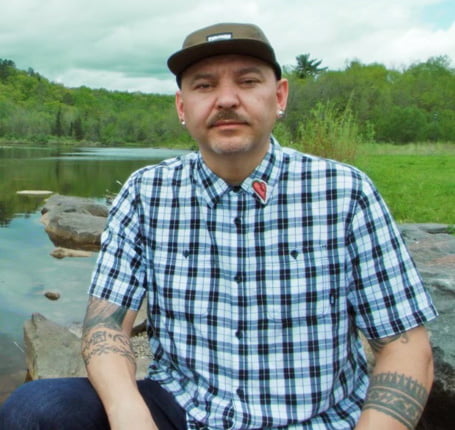
Migizi wiin odoodeman. Bapashkominitigong gii-tazhi-nitaawigi miinawaa go gii-ondaadizi imaa. Ojibwe-Anishinaabe aawi. Ojibwemowin Gegaanzikiged (FDL Gegaanzongejig Ji-Aabadak Ojibwemowin) noongom anokii, mii maa minawaanigozid. Nawaj 20-biboon gaa-kino’amaaged anooj dinowa ezhi-anokiid. Awashime dash ozaagitoon iw zhooshkobagisagoonsibizowin, mii dash geyaabi go ini-jiikendam gaa-ako-maajiitaad 33-biboon!
Naawakwe is Eagle clan. He grew up in the place where he was born, the Bald-headed Island village (Fond du Lac Indian Reservation). He is Ojibwe and currently works for the Fond du Lac Band in the Language and Culture Program as the Ojibwemowin Project Manager where he is fully enjoying himself. He has served as an educator for over 20 years in several different capacities. Naawakwe’s first love is skateboarding, and it still brings him joy after 33 years!

Dylan Bizhikiins Jennings is a member of the marten clan and resides in Odanah, WI with his family. He is an alumnus of UW-Madison with degrees in Anthropology, Archaeology, Environmental Studies, and American Indian Studies. He is currently a graduate student at UW-Nelson Institute where he has dissertator status in the Environment and Resources program.
Jennings served two consecutive terms as an elected Tribal Council Member for the Bad River Tribe and as the Administrator for the Gaa-Miskwaabikaang (Red Cliff) Treaty Natural Resources Division. He was the Director of Public Information for the Great Lakes Indian Fish & Wildlife Commission (GLIFWC) and was a writer, photographer, and editor for the GLIFWC Mazina’igan newspaper. He also served as a member of the Wisconsin Governor’s Task Force on Climate Change and was the first Native American appointed to the Wisconsin Natural Resources Board.
Dylan was an Associate Director for the Sigurd Olson Environmental Institute at Northland College where he taught courses such as Introduction to Ojibwe Language and Culture, American Environmental History, Indigenous Food Sovereignty, and Native Foodways. Bizhikiins currently presents at many public engagements and schools throughout the Midwest on topics about traditional subsistence, sovereignty, tribal environmental perspective and historical preservation, cultural immersion, food sovereignty, Ojibwe language, curriculum, and cultural identity.
Bizhikiins received the “40 under 40” award from the National Center for American Indian Enterprise Development as well as the Rising Star Alumni award from UW-Nelson Institute.
Jennings served two consecutive terms as an elected Tribal Council Member for the Bad River Tribe and as the Administrator for the Gaa-Miskwaabikaang (Red Cliff) Treaty Natural Resources Division. He was the Director of Public Information for the Great Lakes Indian Fish & Wildlife Commission (GLIFWC) and was a writer, photographer, and editor for the GLIFWC Mazina’igan newspaper. He also served as a member of the Wisconsin Governor’s Task Force on Climate Change and was the first Native American appointed to the Wisconsin Natural Resources Board.
Dylan was an Associate Director for the Sigurd Olson Environmental Institute at Northland College where he taught courses such as Introduction to Ojibwe Language and Culture, American Environmental History, Indigenous Food Sovereignty, and Native Foodways. Bizhikiins currently presents at many public engagements and schools throughout the Midwest on topics about traditional subsistence, sovereignty, tribal environmental perspective and historical preservation, cultural immersion, food sovereignty, Ojibwe language, curriculum, and cultural identity.
Bizhikiins received the “40 under 40” award from the National Center for American Indian Enterprise Development as well as the Rising Star Alumni award from UW-Nelson Institute.